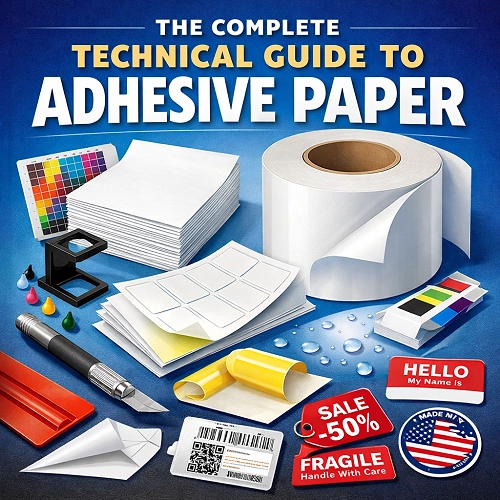
Adhesive paper—also widely referred to as self-adhesive label material, pressure-sensitive label stock, or simply label paper—is a multi-layer composite substrate that combines a printable face material, a pressure-sensitive adhesive, and a release liner into a single, ready-to-apply system. When peeled from its liner and pressed onto a surface, the label bonds without heat, solvent, or water activation.
The global self-adhesive label market is one of the fastest-growing segments in functional packaging materials. According to industry estimates, annual global demand surpasses 55 billion square meters of label stock, driven by growth in food and beverage, pharmaceutical, logistics, and consumer electronics sectors. At the heart of this supply chain sits the manufacturer of raw label material—companies that engineer and produce the foundational substrate rolls that converters then print, die-cut, and supply to brand owners.
Zhejiang Guanhao Functional Material Co., Ltd. is one of China's leading manufacturers of self-adhesive label substrates, operating two modern production bases in Zhejiang and Guangdong provinces with a combined annual output exceeding 1.1 billion square meters. Founded in 2013, the company holds 15+ patents and exports to markets across five continents. Understanding the technical landscape of adhesive paper is central to understanding what companies like Guanhao engineer every day.
The facestock is the visible, printable layer of the label. It determines the label's surface texture, print receptivity, opacity, stiffness, and conformability to irregular surfaces. Facestocks fall into three broad categories: paper-based, film-based, and specialty/synthetic. Paper facestocks remain the most widely used globally due to their printability, die-cuttability, and cost-effectiveness. Films (polyester, polypropylene, polyethylene) dominate applications requiring moisture resistance or high durability.
Caliper (thickness) typically ranges from 50 µm to 120 µm for most commercial-grade paper facestocks. Basis weight—measured in grams per square meter (gsm)—directly correlates with durability; standard copperplate (cast-coated) labels run at 80–90 gsm, while premium grades reach 105 gsm and above.
A thin primer or topcoat (often 2–5 µm) applied to the facestock surface dramatically alters printability. Coatings may be clay-based or polymer-based and are designed to control ink absorption rate, achieve high gloss or matte finishes, prevent feathering in inkjet applications, and resist smearing in thermal-transfer printing. Some premium grades include UV-resistant coatings that resist yellowing and fading under prolonged exposure.
The PSA is the engineering heart of the adhesive paper system. A pressure-sensitive adhesive bonds instantly upon contact with a surface under light finger pressure—no heat, water, or other activation is required. The PSA must satisfy a specific rheological "triangle": adequate tack (initial grab), sufficient peel strength (resistance to removal), and controlled shear resistance (resistance to slow creep under load). Chemically, most commercial PSAs fall into four families: acrylic, rubber-based, hotmelt rubber, and silicone.
Acrylic PSAs dominate the market due to their weatherability, solvent resistance, wide service temperature range (typically –20°C to +80°C for standard grades), and compatibility with both paper and film facestocks. Water-based acrylic emulsion coating has become the industry standard for environmental compliance, displacing older solvent-based systems in most high-volume production lines.
Technical Note — Adhesive Coat Weight
PSA coat weight typically ranges from 16 to 30 g/m² (dry). Higher coat weights increase initial tack and peel strength but may reduce shear resistance and complicate die-cutting due to adhesive bleed. Guanhao's curtain adhesive coating technology enables precise, uniform coat weight across high-speed production runs of 750 m/min.
The release coating is applied to the liner side facing the adhesive. Silicone polymers—anchored to the liner substrate through condensation or UV-curing chemistry—provide an ultra-low surface-energy interface that allows clean separation of adhesive from liner at the point of label dispensing, while retaining full adhesive integrity on the facestock side. Release force (measured in cN/25mm) must be carefully calibrated: too low causes premature delamination during slitting and printing; too high causes label dispensing failures on high-speed applicators.
The release liner serves as carrier substrate during manufacturing, converting, and dispensing, then becomes waste at the point of application. Paper liners—glassine, SCK (supercalendered kraft), or clay-coated kraft—are most common. Film liners (PET, PP) are used for precision die-cutting and high-speed dispensing applications. Linerless labels—which eliminate the release liner entirely—represent a growing sustainability trend reducing liner waste by up to 40% per label.
The adhesive layer is, in many respects, the most technically complex component of the adhesive paper system. Its design must simultaneously satisfy the printing converter (die-cuttability, no adhesive bleed, anti-blocking on roll form), the label applicator (consistent release from liner, reliable dispensing, immediate bond formation), and the end-user (adequate peel strength, shear resistance over the label's service life, compatibility with the application surface).
Water-based acrylic PSAs are produced via emulsion polymerization of acrylic ester monomers (primarily 2-ethylhexyl acrylate, butyl acrylate) with minor amounts of functional monomers (acrylic acid, methacrylic acid) that introduce cross-linkable sites. The glass transition temperature (Tg) of the polymer backbone is the primary variable controlling tack and peel: lower Tg (–40°C to –55°C) yields high-tack permanent adhesives; higher Tg formulations are used for removable grades. Cross-linking density—controlled by the concentration of cross-linker (often aluminium acetylacetonate or aziridine compounds)—governs shear resistance and solvent resistance.
SIS (styrene-isoprene-styrene) and SBS (styrene-butadiene-styrene) block copolymers compounded with tackifying resins and plasticizers form the hotmelt rubber adhesive family. Applied in molten form at 130–180°C and cooled instantly, they offer excellent initial tack and very high peel strength on both polar and non-polar surfaces. However, they exhibit limited UV resistance and reduced performance at elevated temperatures (>60°C), limiting their use in outdoor or high-temperature applications.
For applications on low-energy surfaces (silicones, PTFE, powder-coated metals) or extreme temperature environments (–70°C to +250°C), conventional acrylic or rubber PSAs fail. Polydimethylsiloxane (PDMS)-based PSAs provide adhesion where conventional systems cannot, and are critical in medical-grade labels, aerospace component marking, and high-temperature industrial labels.
| Adhesive Type | Temp. Range | Key Strength | Key Limitation | Typical Applications |
|---|---|---|---|---|
| Water-based Acrylic | –20°C to +80°C | Balance of tack / shear / UV stability | Slow cure in cold conditions | Food & beverage, logistics, pharma |
| Solvent Acrylic | –30°C to +120°C | High-performance, excellent aging | VOC emissions, cost | Industrial, outdoor, electronics |
| Hotmelt Rubber | –10°C to +60°C | Very high initial tack | Limited UV / heat resistance | Retail, packaging, general purpose |
| UV-cured Acrylic | –30°C to +100°C | Fast cure, no VOC, thin coat | Equipment cost | Premium film labels, medical |
| Silicone PSA | –70°C to +250°C | Extreme temperature & surface range | High cost | Aerospace, medical, high-temp industrial |
Selecting the correct adhesive paper specification is not merely a matter of choosing a facestock type. Engineering the correct label for each application demands consideration of application surface energy, application temperature, service temperature, exposure conditions, required label lifespan, printing technology, and dispensing method. The Guanhao application portfolio spans nine distinct end-use sectors, each with its own technical specification requirements.
Drug labels are among the most demanding specifications in the industry. Regulatory requirements in major markets (FDA 21 CFR, EU FMD, China NMPA) mandate machine-readable serialization—2D DataMatrix codes printed at resolutions of 600 DPI or higher on substrates that must remain readable throughout the entire pharmaceutical supply chain. Label adhesives must be pharmaceutical-grade, free from substances that could migrate through packaging into drug products. Additionally, tamper-evidence features (void patterns, destructible facestocks) are frequently specified. Water-resistance is critical as blister packs and vials may encounter condensation in cold-chain logistics.
Logistics labels represent one of the largest volume segments globally—driven by e-commerce growth. The primary technical challenge here is not chemical resistance but throughput and machine compatibility. Labels must dispense at rates exceeding 800 labels/min on high-speed print-and-apply systems. This demands precisely calibrated release force, excellent dimensional stability in the liner (to prevent skew at high speeds), and consistent back-side coefficient of friction to prevent mistracking on applicator rollers.
EU tire labelling regulations (EU 1222/2009, updated 2020) require fuel efficiency, wet grip, and noise ratings to appear on labels that must adhere reliably to new tires throughout storage, shipping, and point-of-sale display. The challenge: tire label adhesives must bond to a highly plasticized, curved rubber surface with low surface energy (28–34 mN/m)—one of the most difficult substrates for PSA bonding. Specialized all-weather permanent adhesives with enhanced wetting agents and optimized acrylic backbone polarity are formulated specifically for this application.
Daily chemical and drinking water label materials must comply with food contact safety standards (FDA, EU 10/2011 Regulation, GB 4806 in China). Labels for bottles subjected to ice-bucket or moisture environments require cold-water-resistant adhesives that retain peel strength when the substrate surface is wet or contaminated. BOPP and PET film facestocks—with their inherent moisture resistance—are widely used in this segment for film adhesive labels.
The printability of an adhesive paper substrate must be engineered to match the specific printing technology used by the converter. The six dominant printing technologies in label conversion each impose different requirements on the facestock coating, ink system, and adhesive.
Flexographic printing is the workhorse of the label industry, combining high throughput, cost efficiency, and excellent compatibility with UV-curable, water-based, and solvent-based ink systems. It is the default choice for medium-to-large production runs of food, beverage, and logistics labels. The copperplate paper adhesive facestock range is particularly optimised for flexo printing, offering rapid ink setting and high gloss retention.
Digital inkjet—particularly UV-inkjet and aqueous dye/pigment systems—has disrupted the label printing market over the past decade, enabling cost-effective short runs, variable data, and on-demand printing without plate costs. Inkjet labels require facestocks with controlled porosity and specially designed coatings that arrest ink droplets precisely without feathering. Guanhao's woodfree adhesive grades offer high ink absorbency suitable for inkjet applications requiring matte, natural-look results.
The adhesive paper industry generates substantial quantities of release liner waste—often accounting for 30–40% of the total weight of a label roll. In a market consuming 55+ billion m² annually, this represents a significant material sustainability challenge. Progressive manufacturers and brand owners are addressing this through several converging strategies.
Linerless labels eliminate the release liner entirely. The facestock is coated with a silicone topcoat, and the label roll is wound adhesive-to-silicone without a liner. A specialized printer with a non-stick platen cuts and dispenses labels on demand. While the technology eliminates all liner waste, it requires dedicated printer hardware and is currently limited in printing resolution, substrates, and label complexity. Growth is expected in supermarket weigh-price labels and quick-service restaurant applications.
Recycled paper facestocks using post-consumer waste (PCW) fibre are commercially available and suitable for many logistics and retail label applications. Bio-based PLA (polylactic acid) film labels are emerging as compostable alternatives to conventional BOPP for consumer product labels, though performance in humid environments remains a challenge. Guanhao's recent recognition as a "Zero-Waste Factory" by the Jiaxing Municipal Bureau of Ecology and Environment reflects the industry trend toward comprehensive environmental management in label manufacturing.
For packaging recyclability, labels on PET and HDPE bottles must be removable during the washing and sorting process at recycling facilities. Wash-off adhesives—based on water-sensitive or alkali-soluble PSA formulations—dissolve cleanly at 60–80°C in recycling wash baths, releasing the label and preventing contamination of the recycled polymer. This technology is increasingly mandated by recycling compliance schemes in the EU and is specified by major FMCG brands.
Industry Update — Zero-Waste Factory Certification
Zhejiang Guanhao Functional Material Co., Ltd. was officially recognized as a "Zero-Waste Factory" in 2024 by the Jiaxing Municipal Bureau of Ecology and Environment. Read the full announcement on Guanhao's company news page. This designation reflects systematic waste reduction across production, water management, and materials usage—an increasingly important credential for global label buyers managing supplier ESG requirements.
Adhesive paper is assessed against a comprehensive battery of physical, chemical, and application-performance tests before commercial release. Testing standards are defined by several international bodies including FINAT (European self-adhesive label trade association), TLMI (North America), PSTC, ASTM, and ISO. The principal test methods cover:
| Test Property | Standard | Procedure Summary | Typical Acceptance Range |
|---|---|---|---|
| Peel Adhesion (180°) | FINAT FTM 1 | Strip peeled at 300 mm/min from stainless steel after 20 min dwell | 8–20 N/25mm (permanent grades) |
| Loop Tack | FINAT FTM 9 | Adhesive loop pressed onto SS at 300 mm/min, immediately retracted | 6–18 N/25mm |
| Shear Resistance | FINAT FTM 8 | 500g / 1kg load on vertical SS panel, time to failure measured | >10,000 min (permanent grades) |
| Release Force | FINAT FTM 3 | Liner peeled at 300 mm/min from laminates; force in cN/25mm | 5–30 cN/25mm |
| Die-cutting Performance | FINAT FTM 26 | Adhesive bleed on die-cut edge evaluated under magnification | Zero visible bleed at ×10 magnification |
| Temperature Resistance | Internal / Supplier | Conditioned samples aged at target temperature; peel tested post-aging | Grade-specific |
Choosing the correct adhesive paper for a given application follows a structured decision process. The framework below provides a practical starting point for buyers, label converters, and procurement managers evaluating adhesive paper specifications.
Zhejiang Guanhao Functional Material Co., Ltd. was established in 2013 and has grown into one of the most technically capable adhesive paper manufacturers in Asia. The company operates across two modern facilities—one in Zhejiang Province and a second production base in Guangdong—combining a total annual output of over 1.1 billion square meters of self-adhesive label material.
Guanhao's technology partnership with BMB of Switzerland enables the deployment of six-roll silicone oil coating and curtain adhesive coating at throughput speeds of 750 m/min—among the highest sustainable production speeds in the global label stock industry. This capacity serves a diverse customer base spanning food and beverages, home appliances, healthcare, electronics, logistics, transportation, and chemicals.
The company holds 15+ patents and maintains a rigorous R&D programme, independently designing and producing products based on customer specifications and market-driven innovation. Its quality management system encompasses strict raw material procurement controls, in-process monitoring, and finished-goods release testing aligned with major international label standards (FINAT, ISO).
Guanhao's international expansion is ongoing, with products exported to customers across five continents. Recent exhibition activity—including participation in the 2025 Foodaily Global Food & Beverage Innovation Expo and Label Expo Europe 2025—underscores the company's commitment to engaging global markets and showcasing technical innovation to international buyers.
For buyers seeking high-quality self-adhesive label material in thermal, copperplate, film, or woodfree specifications, the Guanhao product range offers a comprehensive solution portfolio. Customisation capabilities—based on customer drawings or samples—mean that OEM and private-label specifications can be developed with the full support of Guanhao's in-house R&D team.