
PP Film Adhesive Paper is a self-adhesive laminate constructed from a biaxially oriented or cast polypropylene (PP) face stock, a pressure-sensitive adhesive layer, and a silicone-coated release liner. The polypropylene polymer backbone gives the material exceptional clarity, chemical inertness, and dimensional stability — properties that paper-based facestocks simply cannot match in demanding environments.
Within the broader film adhesive product family — which also includes PE Film Adhesive, BOPP Film Adhesive, and PET Film Adhesive — PP film occupies a cost-performance sweet spot: more rigid and chemically resistant than PE, more flexible and cost-effective than PET.
Understanding the three-layer structure is essential for selecting the right grade and predicting real-world performance.
| Layer | Material | Typical Thickness | Primary Function |
|---|---|---|---|
| Face Stock | Cast PP or BOPP Film | 40–100 µm | Print surface; provides structural integrity, gloss, or matte appearance |
| Adhesive | Acrylic or rubber-based PSA | 15–30 µm | Bonds label to substrate; permanent or removable |
| Release Liner | Glassine, PE-coated paper, or PET | 60–90 µm | Protects adhesive during storage; enables die-cutting and dispensing |
PP film is available in two primary orientations, each suited to different applications:
Produced by casting molten polymer onto a chill roll. Offers superior conformability for curved or irregular surfaces. Preferred for daily chemical and beverage containers.
Stretched in both machine and transverse directions, yielding higher tensile strength and optical clarity. Ideal for retail labels where shelf impact matters.
Pigmented face stock that blocks substrate color from showing through. Common in pharmaceutical and drug labels where legibility is critical.
Vacuum-metalized or holographic surface for premium aesthetics. Explore Plain Laser Film Paper for this effect.
The specifications below reflect the standard grades supplied by Zhejiang Guanhao Functional Material Co., Ltd.. Custom configurations are available on request.
| Parameter | Standard Range | Custom Options |
|---|---|---|
| Face Stock Material | Polypropylene (PP) Film | CPP, BOPP, white, transparent, metalized |
| Total Caliper (thickness) | 60–120 µm | Down to 40 µm or up to 150 µm |
| Adhesive Type | Permanent acrylic PSA | Removable, ultra-permanent, freezer-grade |
| Surface Finish | Glossy, matte, semi-gloss | Soft-touch, anti-scuff, UV-varnish |
| Roll Width | 50–500 mm | Up to 1,000 mm (full-web) |
| Core Diameter | 76 mm (3 in) | 40 mm, 152 mm |
| Temperature Resistance | -20°C to +80°C | Freezer: -40°C; High-temp: up to +110°C |
| Moisture Vapor Transmission | <5 g/m²/day (38°C/90%RH) | Barrier-coated grades available |
| Peel Adhesion (steel, 180°) | ≥8 N/25mm | Up to 25 N/25mm ultra-bond grade |
| Tensile Strength (MD) | ≥35 MPa | ≥60 MPa (BOPP high-strength) |
One of the strongest competitive advantages of PP film is its compatibility with virtually every modern digital and analogue print process. The corona-treated surface accepts ink and toner reliably when the correct settings and consumables are used.
| Print Method | Ink/Toner Type | Recommended PP Grade | Key Consideration |
|---|---|---|---|
| Thermal Transfer (TTO/TTR) | Wax-resin or full-resin ribbon | White matte PP | Use resin ribbon for chemical resistance; verify ribbon-face compatibility |
| UV Inkjet (digital) | UV-curable pigment ink | Glossy or matte transparent PP | Instant cure; excellent colour gamut on clear film |
| Offset Lithography | UV offset inks | BOPP gloss white | High-speed, high-volume; requires varnish or lamination for scuff resistance |
| Flexography | Water-based or UV flexo inks | CPP or BOPP | Dominant process for roll-label production; excellent registration |
| Laser (dry toner) | Dry electrostatic toner | Laser-receptive PP | Requires dedicated laser-receptive coating; standard PP may cause wrinkle |
| Screen Printing | Solvent or UV screen inks | White or clear PP | Ideal for thick ink deposits and specialty effects (metallic, glitter) |
PP film is inherently hydrophobic. Labels retain adhesion and legibility in refrigeration, outdoor humidity, and wash-down environments.
UV-stabilized grades resist yellowing and print fade for outdoor or sun-exposed applications such as tire labels.
Withstands alcohols, oils, cleaning agents, and mild acids — critical for industrial labels and lab-sample identification.
High tensile strength prevents accidental tearing during dispensing, application, and in-service use on packaging lines.
Performs from freezer storage (-20°C) through hot-fill and sterilization cycles (up to +80°C standard; higher with speciality adhesives).
PP is classified as resin code #5 and is accepted in many municipal recycling streams, supporting brands' sustainability commitments.
The breadth of PP film adhesive paper use cases spans virtually every sector. Below is a summary of the most significant applications, with links to the corresponding Guanhao application pages.
| Industry | Typical Use Case | Recommended Grade | Learn More |
|---|---|---|---|
| Food & Beverage | Bottle labels, jar lids, frozen-food pouches | Clear CPP, glossy white PP | Drinking Water Labels |
| Daily Chemical | Shampoo, detergent, cosmetic packaging | Glossy BOPP, soft-touch matte | Daily Chemical Labels |
| Pharmaceuticals | Medicine bottles, blister packs, device labeling | White opaque PP, tamper-evident | Drug Labels |
| Logistics & Warehousing | Barcode/QR shipping labels, pallet tags | White matte PP (thermal-transfer) | Logistics Labels |
| Retail | Price tags, promotional stickers, shelf labels | Glossy white or transparent PP | Retail Labels |
| Electronics | Asset tags, UL/CE compliance labels, ESD labels | Matte white PP, anti-static | Electronic Labels |
| Automotive / Tire | Tire ID, tread-depth, regulatory marks | UV-resistant white PP | Tire Labels |
| Office / Desktop | A4 sheet labels, address labels, name badges | Laser-receptive white PP | A4 Flat Sheet Labels |
Guanhao's film adhesive range includes PE, BOPP, and PET in addition to standard PP. Choosing the right film depends on the balance of mechanical strength, flexibility, cost, and chemical resistance required.
| Property | PP Film | PE Film | BOPP Film | PET Film |
|---|---|---|---|---|
| Tensile Strength | ★★★☆☆ | ★★☆☆☆ | ★★★★☆ | ★★★★★ |
| Flexibility / Conformability | ★★★★☆ | ★★★★★ | ★★★☆☆ | ★★☆☆☆ |
| Chemical Resistance | ★★★★☆ | ★★★☆☆ | ★★★★☆ | ★★★★★ |
| Optical Clarity | ★★★★☆ | ★★★☆☆ | ★★★★★ | ★★★★★ |
| Heat Resistance | ★★★☆☆ | ★★☆☆☆ | ★★★☆☆ | ★★★★★ |
| Cost Efficiency | ★★★★☆ | ★★★★★ | ★★★★☆ | ★★★☆☆ |
| Recyclability | ★★★★☆ | ★★★★★ | ★★★☆☆ | ★★★☆☆ |
★ = Low ★★★★★ = High. Ratings are comparative across the four film types.
The most common cause of label failure is inadequate surface preparation. The substrate must be clean, dry, and free from dust, grease, release agents, and plasticizers. For low-surface-energy plastics (PE, PP containers), a brief solvent wipe with IPA (isopropyl alcohol) or a flame/corona pre-treatment significantly improves initial adhesion.
Apply PP film adhesive labels at substrate temperatures between +10°C and +40°C. Below +10°C the adhesive becomes stiffer, reducing wet-out and initial tack. Above +40°C adhesive flow increases, which can cause label repositioning or edge lift before full cure.
Store rolls in a cool, dry location at 15–25°C and 40–60% relative humidity. Keep away from direct sunlight and sources of ozone (electric motors, UV lamps). Under ideal conditions, shelf life is 12–24 months from manufacture date.
PP film can be die-cut with rotary steel-rule or flatbed dies. Use sharp blades and avoid excessive nicking depth that penetrates the liner. For automated dispensing, set dispenser peel angle at 45°–160° and confirm label gap detection with sensor calibration.
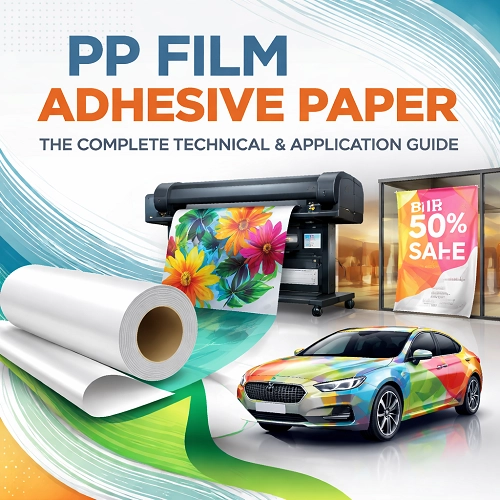
The label industry is under growing pressure to reduce environmental impact. PP film adhesive materials address several sustainability dimensions:
Unlike PVC film, PP contains no chlorine and produces lower dioxin emissions during end-of-life incineration. Guanhao's commitment to eco-conscious manufacturing aligns with global brand owners' sustainability goals. For more on product range and company vision, visit the About Us page.
While Copperplate Paper Adhesive and Woodfree Adhesive remain popular for cost-sensitive applications, PP film offers clear advantages in demanding environments.
| Criteria | PP Film Adhesive | Copperplate Paper Adhesive | Woodfree Paper Adhesive |
|---|---|---|---|
| Water Resistance | Excellent | Poor | Poor |
| Tear Resistance | Excellent | Moderate | Low |
| Print Quality (photo) | Excellent | Very Good | Good |
| Conformability | Very Good | Limited | Limited |
| Material Cost | Medium-High | Low-Medium | Low |
| Outdoor Durability | 2–5 years | 3–6 months | 1–3 months |
| Best For | Harsh environments, premium labels | High-print, indoor labels | Variable data, general office |